Faced with extinction, the devils fight back

Devil with DFTD

The researchers looked at animals at risk of catching transmissible cancer, known as devil facial tumour disease (DFTD), which has been driving the species toward possible extinction over the past two decades, and found unexpected signs of immunity, including elevated levels of certain immune system molecules which reduce their likelihood of getting the disease.

Active immune responses to DFTD and even tumour regression have recently been observed in several animals, showing a very promising sign that could be exploited for the management of the species,” says lead author Beata Ujvari from Deakin University’s School of Life and Environmental Sciences in Melbourne, Australia.

Read all about it: Research finds clues that Tasmanian devils are adapting to the cancer that threatens their existence by Andrew P Street @ Cosmos – The Science of Everything.

Evolved Dependence in Response to Cancer

Authors: Frédéric Thomas, Irina Kareva, Nynke Raven, Rodrigo Hamede, Pascal Pujol, Benjamin Roche & Beata Ujvari

Source: Trends in Ecology and Evolution (Available online 20 February 2018)

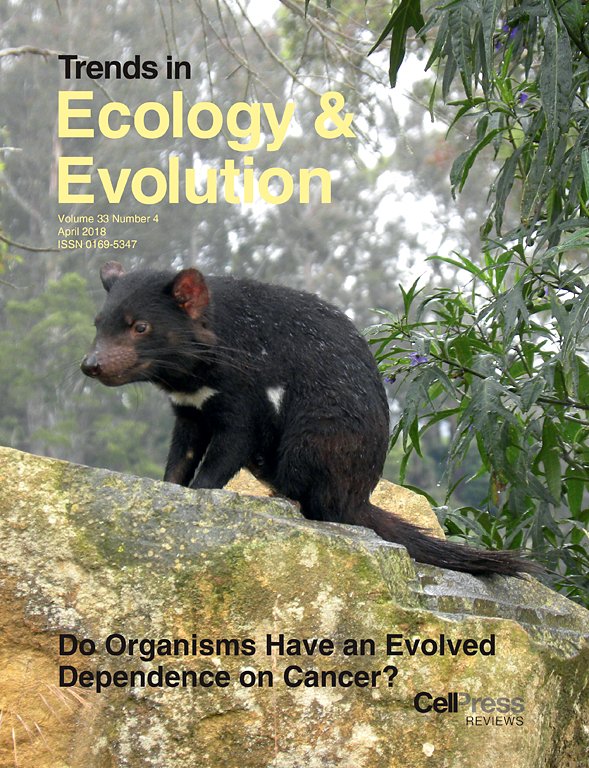
Brief summary of the paper: Evolved dependence is frequent in evolutionary interactions between hosts and parasites. Similar to pathogens, oncogenic manifestations drive host adaptive responses. Multicellular organisms display evolved dependence in response to oncogenic processes. Evolved dependence in response to cancer has implications for prevention and treatment.


Evolved dependence is a process through which one species becomes ‘dependent’ on another following a long evolutionary history of interaction. This happens when adaptations selected in the first species for interacting lead to fitness costs when the second species is not encountered.

Evolved dependence is frequent in host–parasite interactions, where hosts may achieve a higher fitness in the presence of the parasite than in its absence. Since oncogenic manifestations are (i) ubiquitous across multicellular life, (ii) involved in parasitic-like interactions with their hosts, and (iii) have effectively driven the selection of numerous adaptations, it is possible that multicellular organisms display evolved dependence in response to oncogenic processes.

We provide a comprehensive overview of the topic, including the implications for cancer prevention and treatment.

Cancer Is Not (Only) a Senescence Problem

Authors: Frédéric Thomas, Fabrice Vavre, Tazzio Tissot, Marion Vittecoq, Mathieu Giraudeau, Florence Bernex, Dorothée Misse, François Renaud, Nynke Raven, Christa Beckmann, Rodrigo Hamede, Peter A. Biro & Beata Ujvari

Source: Trends in Cancer, Volume 4, Issue 3, p169–172, March 2018

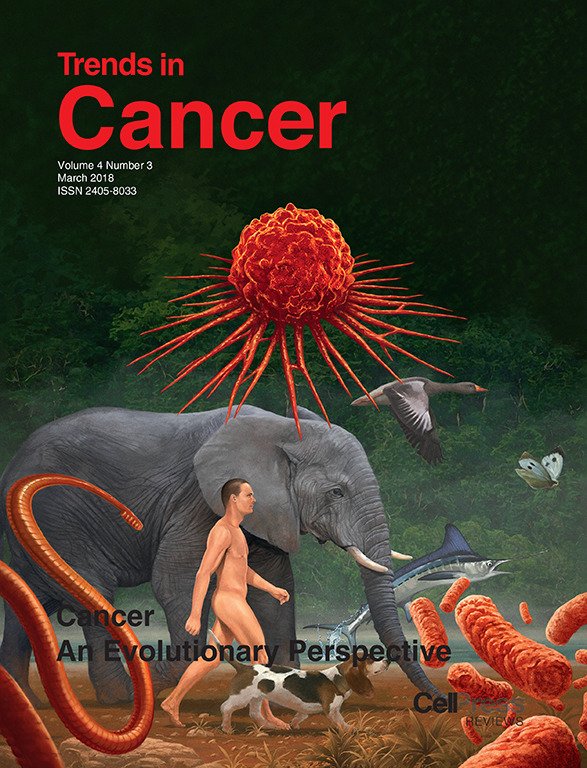
Brief summary of the paper: Age is one of the strongest predictors of cancer and risk of death from cancer. Cancer is therefore generally viewed as a senescence-related malady.

However, cancer also exists at subclinical levels in humans and other animals, but its earlier effects on the body are poorly known by comparison.

We argue here that cancer is a significant but ignored burden on the body and is likely to be a strong selective force from early during the lifetime of an organism. It is time to adopt this novel view of malignant pathologies to improve our understanding of the ways in which oncogenic phenomena influence the ecology and evolution of animals long before their negative impacts become evident and fatal.

Turning natural adaptations to oncogenic factors into an ally in the war against cancer

Beata U.

Authors: Marion Vittecoq, Mathieu Giraudeau, Tuul Sepp, David J. Marcogliese, Marcel Klaassen, François Renaud, Beata Ujvari & Frédéric Thomas

Source: Evolutionary Applications (14 March 2018)

Brief summary of the paper: Both field and experimental evolution studies have demonstrated that organisms naturally or artificially exposed to environmental oncogenic factors can, sometimes rapidly, evolve specific adaptations to cope with pollutants and their adverse effects on fitness.

Although numerous pollutants are mutagenic and carcinogenic, little attention has been given to exploring the extent to which adaptations displayed by organisms living in oncogenic environments could inspire novel cancer treatments, through mimicking the processes allowing these organisms to prevent or limit malignant progression.

Building on a substantial knowledge base from the literature, we here present and discuss this progressive and promising research direction, advocating closer collaboration between the fields of medicine, ecology, and evolution in the war against cancer.

Cancer adaptations: Atavism, de novo selection, or something in between?

Authors: Frédéric Thomas, Beata Ujvari, François Renaud, Mark Vincent

Source: BioEssays Volume 39, Issue 8, August 2017

Brief summary of the paper: From an evolutionary perspective, both atavism and somatic evolution/convergent evolution theories can account for the consistent occurrence, and astounding attributes of cancers: being able to evolve from a single cell to a complex organized system, and malignant transformations showing significant similarities across organs, individuals, and species.

Here, we first provide an overview of these two hypotheses, including the possibility of them not being mutually exclusive, but rather potentially representing the two extremes of a continuum in which the diversity of cancers can emerge.

In reviewing the current literature, we also discuss the criteria that should be applied to discriminate between the two competing theories and to determine their relevant contributions to oncogenesis and cancer progression.

Finally, we deliberate on the potential applications of this conceptual framework in developing novel treatment strategies.

Changes in diet associated with cancer: An evolutionary perspective

Beata U.

Authors: Frédéric Thomas, Sophie Rome, Frédéric Mery, Erika Dawson, Jacques Montagne, Peter A. Biro, Christa Beckmann, François Renaud, Robert Poulin, Michel Raymond, Beata Ujvari

SourceEvolutionary Applications, Volume 10, Issue 7, Pages 651–657, August 2017

Brief summary of the paper: Changes in diet are frequently correlated with the occurrence and progression of malignant tumors (i.e., cancer) in both humans and other animals, but an integrated conceptual framework to interpret these changes still needs to be developed.

Our aim is to provide a new perspective on dietary changes in tumor-bearing individuals by adapting concepts from parasitology. Dietary changes may occur alongside tumor progression for several reasons: (i) as a pathological side effect with no adaptive value, (ii) as the result of self-medication by the host to eradicate the tumor and/or to slow down its progression, (iii) as a result of host manipulation by the tumor that benefits its progression, and finally (iv) as a host tolerance strategy, to alleviate and repair damages caused by tumor progression.

Surprisingly, this tolerance strategy can be beneficial for the host even if diet changes are beneficial to tumor progression, provided that cancer-induced death occurs sufficiently late (i.e., when natural selection is weak).

We argue that more data and a unifying evolutionary framework, especially during the early stages of tumorigenesis, are needed to understand the links between changes in diet and tumor progression. We argue that a focus on dietary changes accompanying tumor progression can offer novel preventive and therapeutic strategies against cancer.

What can Tasmanian devils teach us about cancer?

Something extraordinary is evolving among the feisty inhabitants of the remote north-west coast of Tasmania. Something that’s both astounding and delighting the researchers monitoring them.

For more than 20 years, these apple-isle locals have been suffering an ugly cancer that’s caused population numbers to rapidly decline. The problem has raised many complex questions and stirred urgent conservation efforts among research institutions around the world. But now, in an unprecedented and ground-breaking discovery, an isolated colony of Tasmanian devils appear to be saving themselves from extinction.

Having immersed herself and her research in the devil’s world for a number of years, Dr Beata Ujvari, an evolutionary ecologist and Senior Lecturer in Bioinformatics and Genetics at Deakin University, is excited by the new findings. ‘Encouragingly, the results suggest the devils may be able to overcome the extinction threat of the disease that has devastated the population for over two decades.’

Read more on this new and exciting research by Dr Beata Ujvari via Deakin (this.)


PhD Position @ UTAS: Learning to Live with Cancer – Local adaptations to transmissible tumours in Tasmanian devils

Tasmanian Devil Facial Tumour Disease

University of Tasmania is urgently looking for a PhD student to work on the diseases ecology and epidemiology of Tasmanian devil facial tumour disease.

The student will be based in Tasmania at the University of Tasmania, and will be supervised by Dr Rodrigo Hamede. The student will receive a 3 year PhD stipend, and if it’s an international student, then the offer comes with a tuition fee waiver, so no costs for the candidate.

They are looking for an outstanding candidate who is keen on doing fieldwork and ready to work with this iconic species.

Start date: As soon as possible.

For full details on this position CLICK HERE.

If you are or know a potential candidate, please pass on the details to her/him and ask the student to get in touch directly with Dr Rodrigo Hamede.

Purifying selection and concerted evolution of RNA-sensing toll-like receptors in migratory waders

Nynke R., Thomas M. and Beata U.

Authors: Nynke Raven, Simeon Lisovski, Marcel Klaassen, Nathan Lo, Thomas Madsen, Simon Y.W. Ho, Beata Ujvari

Source: Infection, Genetics and Evolution (Available online 18 May 2017)

Brief summary of the paper: Migratory birds encounter a broad range of pathogens during their journeys, making them ideal models for studying immune gene evolution. Despite the potential value of these species to immunoecology and disease epidemiology, previous studies have typically focused on their adaptive immune gene repertoires.

In this study, we examined the evolution of innate immune genes in three long-distance migratory waders (order Charadriiformes). We analysed two parts of the extracellular domains of two Toll-like receptors (TLR3 and TLR7) involved in virus recognition in the Sanderling (Calidris alba), Red-necked Stint (Calidris ruficollis), and Ruddy Turnstone (Arenaria interpres). Our analysis was extended to 50 avian species for which whole-genome sequences were available, including two additional waders.

We found that the inferred relationships among avian TLR3 and TLR7 do not match the whole-genome phylogeny of birds. Further analyses showed that although both loci are predominantly under purifying selection, the evolution of the extracellular domain of avian TLR3 has also been driven by episodic diversifying selection. TLR7 was found to be duplicated in all five wader species and in two other orders of birds, Cuculiformes and Passeriformes.

The duplication is likely to have occurred in the ancestor of each order, and the duplicated copies appear to be undergoing concerted evolution. The phylogenetic relationships of wader TLR7 matched those of the five wader species, but that of TLR3 did not. Instead, the tree inferred from TLR3 showed potential associations with the species’ ecology, including migratory behaviour and exposure to pathogens.

Our study demonstrates the importance of combining immunological and ecological knowledge to understand the impact of immune gene polymorphism on the evolutionary ecology of infectious diseases.

Infections and cancer: the “fifty shades of immunity” hypothesis

Beata U.

Authors: Jacqueline, Camille; Tasiemski, Aurelie; Sorci, Gabriele; Ujvari, Beata; Maachi, Fatima; Misse, Dorothee; Renaud, Francois; Ewald, Paul; Thomas, Frederic; Roche, Benjamin

Source: BMC CANCER, 17, APR 12 2017

Brief summary of the paper:

Background: Since the beginning of the twentieth century, infection has emerged as a fundamental aspect of cancer causation with a growing number of pathogens recognized as oncogenic. Meanwhile, oncolytic viruses have also attracted considerable interest as possible agents of tumor destruction.

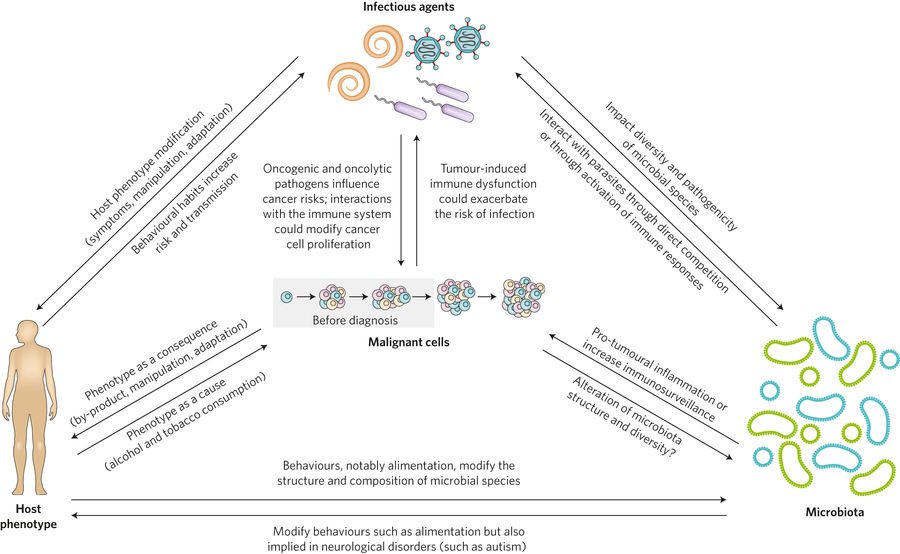
Discussion: Lost in the dichotomy between oncogenic and oncolytic agents, the indirect influence of infectious organisms on carcinogenesis has been largely unexplored. We describe the various ways – from functional aspects to evolutionary considerations such as modernity mismatches – by which infectious organisms could interfere with oncogenic processes through immunity. Finally, we discuss how acknowledging these interactions might impact public health approaches and suggest new guidelines for therapeutic and preventive strategies both at individual and population levels.

Summary: Infectious organisms, that are not oncogenic neither oncolytic, may play a significant role in carcinogenesis, suggesting the need to increase our knowledge about immune interactions between infections and cancer.