The impact of food availability on tumorigenesis is evolutionarily conserved

Authors: Sophie Tissot, Lena Guimard, Jordan Meliani, Justine Boutry, Antoine M. Dujon, Jean-Pascal Capp, Jácint Tökölyi, Peter A. Biro, Christa Beckmann, Laura Fontenille, Nam Do Khoa, Rodrigo Hamede, Benjamin Roche, Beata Ujvari, Aurora M. Nedelcu & Frédéric Thomas

Source: Scientific Reports (Nov 2023)
Abstract

The inability to control cell proliferation results in the formation of tumors in many multicellular lineages. Nonetheless, little is known about the extent of conservation of the biological traits and ecological factors that promote or inhibit tumorigenesis across the metazoan tree. Particularly, changes in food availability have been linked to increased cancer incidence in humans, as an outcome of evolutionary mismatch.

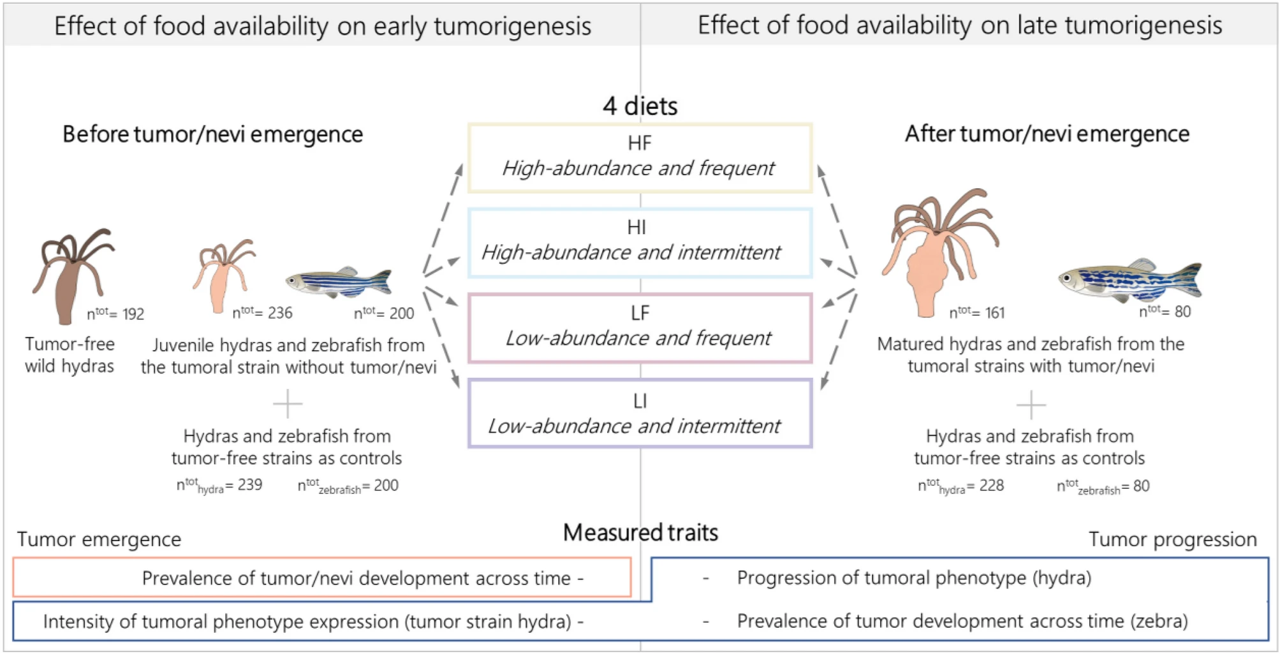
Here, we apply evolutionary oncology principles to test whether food availability, regardless of the multicellular lineage considered, has an impact on tumorigenesis. We used two phylogenetically unrelated model systems, the cnidarian Hydra oligactis and the fish Danio rerio, to investigate the impact of resource availability on tumor occurrence and progression. Individuals from healthy and tumor-prone lines were placed on four diets that differed in feeding frequency and quantity. For both models, frequent overfeeding favored tumor emergence, while lean diets appeared more protective. In terms of tumor progression, high food availability promoted it, whereas low resources controlled it, but without having a curative effect.

We discuss our results in light of current ideas about the possible conservation of basic processes governing cancer in metazoans (including ancestral life history trade-offs at the cell level) and in the framework of evolutionary medicine.
Toxoplasma gondii infection in people with schizophrenia is related to higher hair glucocorticoid levels

Authors: Emy Beaumont, Jacques Brodeur, Frédéric Thomas, Antoine M Dujon; Consortium Signature; Sonia J Lupien

Source: Frontiers in Psychiatry (Feb 2024)

Abstract

Introduction: Toxoplasma gondii (TG) is a common protozoan parasite infecting approximately one third of the human population. Animal studies have shown that this parasite can manipulate its host behavior. Based on this, human studies have assessed if TG can be involved in mental health disorders associated with important behavioral modifications such as schizophrenia. However, results have been discrepant. Given that TG has a strong impact on fear and risk-taking processes in animal studies and that fear and risk-taking behaviors are associated with the human stress response, we tested whether glucocorticoid biomarkers (salivary and hair) differ in people with schizophrenia and controls as a function of TG status.

Methods: We measured TG antibodies in blood samples, as well as salivary and hair glucocorticoid levels in 226 people with schizophrenia (19.9% women, mean age = 39 years old) and 129 healthy individuals (controls) (45.7% women, mean age = 41 years old).

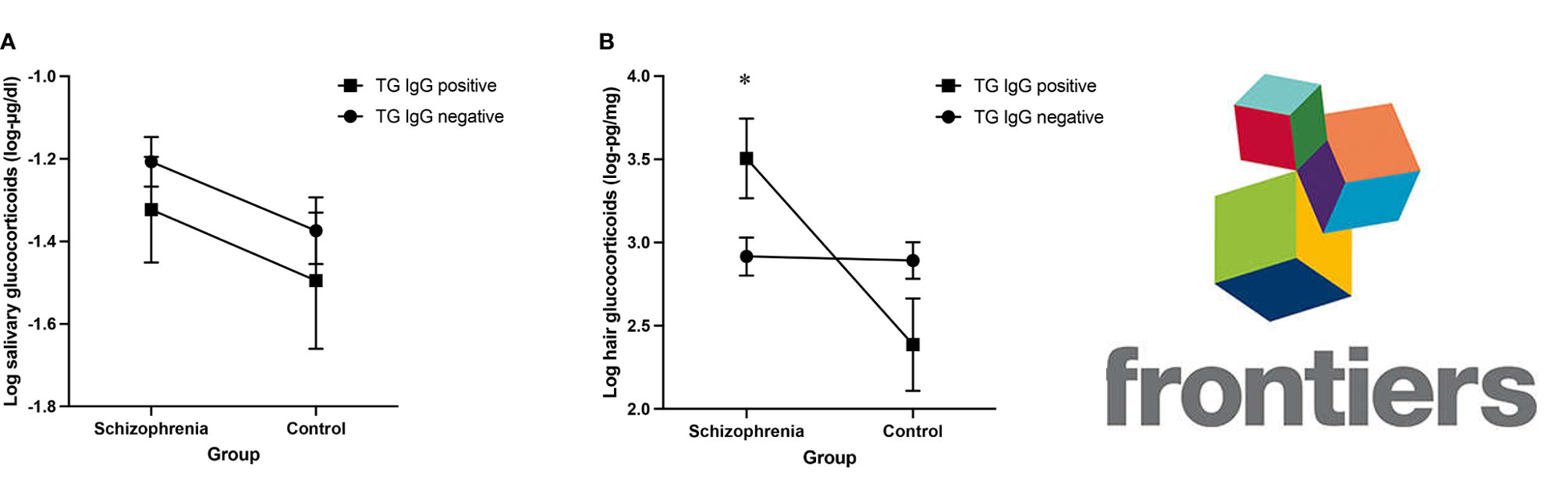
Results: The results showed that people with schizophrenia infected with TG presented significantly higher hair glucocorticoid concentrations than non-infected people with schizophrenia. This effect was not found in control participants. No effect was observed for salivary glucocorticoid levels. Additionally, there were no associations between TG infection and positive psychotic symptoms nor impulsivity.

Discussion: These results show that people with schizophrenia present high levels of hair glucocorticoid levels only when they are infected with TG. Further studies performed in populations suffering from other mental health disorders are needed to determine if this effect is specific to schizophrenia, or whether it is generalized across mental health disorders.

Complex associations between cancer progression and immune gene expression reveals early influence of transmissible cancer on Tasmanian devils

Authors: Nynke Raven, Marcel Klaassen, Thomas Madsen, Menna Jones, David G. Hamilton, Manuel Ruiz-Aravena, Frederic Thomas, Rodrigo K. Hamede & Beata Ujvari

Source: Frontiers in Immunology (Mar 2024)

Abstract

The world’s largest extant carnivorous marsupial, the Tasmanian devil, is challenged by Devil Facial Tumor Disease (DFTD), a fatal, clonally transmitted cancer. In two decades, DFTD has spread across 95% of the species distributional range. A previous study has shown that factors such as season, geographic location, and infection with DFTD can impact the expression of immune genes in Tasmanian devils.

To date, no study has investigated within-individual immune gene expression changes prior to and throughout the course of DFTD infection. To explore possible changes in immune response, we investigated four locations across Tasmania that differed in DFTD exposure history, ranging between 2 and >30 years. Our study demonstrated considerable complexity in the immune responses to DFTD. The same factors (sex, age, season, location and DFTD infection) affected immune gene expression both across and within devils, although seasonal and location specific variations were diminished in DFTD affected devils.

We also found that expression of both adaptive and innate immune genes starts to alter early in DFTD infection and continues to change as DFTD progresses. A novel finding was that the lower expression of immune genes MHC-II, NKG2D and CD8 may predict susceptibility to earlier DFTD infection. A case study of a single devil with regressed tumor showed opposite/contrasting immune gene expression patterns compared to the general trends observed across devils with DFTD infection.

Our study highlights the complexity of DFTD’s interactions with the host immune system and the need for long-term studies to fully understand how DFTD alters the evolutionary trajectory of devil immunity.

In vitro competition between two transmissible cancers and potential implications for their host, the Tasmanian devil

Authors: Anne-Lise Gérard, Rachel S Owen, Antoine M. Dujon, Benjamin Roche, Rodrigo Hamede, Frédéric Thomas, Beata Ujvari, Hannah V Siddle

Source: Evolutionary Applications (Mar 2024)

Abstract

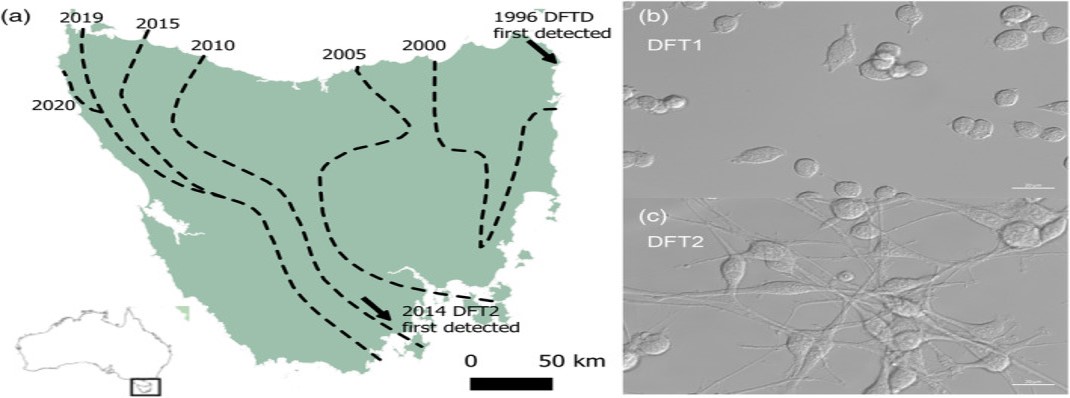
Since the emergence of a transmissible cancer, devil facial tumour disease (DFT1), in the 1980s, wild Tasmanian devil populations have been in decline. In 2016, a second, independently evolved transmissible cancer (DFT2) was discovered raising concerns for survival of the host species.

Here, we applied experimental and modelling frameworks to examine competition dynamics between the two transmissible cancers in vitro. Using representative cell lines for DFT1 and DFT2, we have found that in monoculture, DFT2 grows twice as fast as DFT1 but reaches lower maximum cell densities. Using co-cultures, we demonstrate that DFT2 outcompetes DFT1: the number of DFT1 cells decreasing over time, never reaching exponential growth. This phenomenon could not be replicated when cells were grown separated by a semi-permeable membrane, consistent with exertion of mechanical stress on DFT1 cells by DFT2.

A logistic model and a Lotka-Volterra competition model were used to interrogate monoculture and co-culture growth curves, respectively, suggesting DFT2 is a better competitor than DFT1, but also showing that competition outcomes might depend on the initial number of cells, at least in the laboratory.

We provide theories how the in vitro results could be translated to observations in the wild and propose that these results may indicate that although DFT2 is currently in a smaller geographic area than DFT1, it could have the potential to outcompete DFT1. Furthermore, we provide a framework for improving the parameterization of epidemiological models applied to these cancer lineages, which will inform future disease management.

Behavioural ecology meets oncology: quantifying the recovery of animal behaviour to a transient exposure to a cancer risk factor

Authors: Hiske Klaassen, Sophie Tissot, Jordan Meliani, Justine Boutry, Anna Miltiadous, Peter A. Biro, David J. Mitchell, Beata Ujvari, Aaron Schultz, Frédéric Thomas and Antoine M. Dujon

Source: Proceedings of the Royal Society B (Feb 2024)

Abstract

Wildlife is increasingly exposed to sublethal transient cancer risk factors, including mutagenic substances, which activates their anti-cancer defences, promotes tumourigenesis, and may negatively impact populations. Little is known about how exposure to cancer risk factors impacts the behaviour of wildlife.

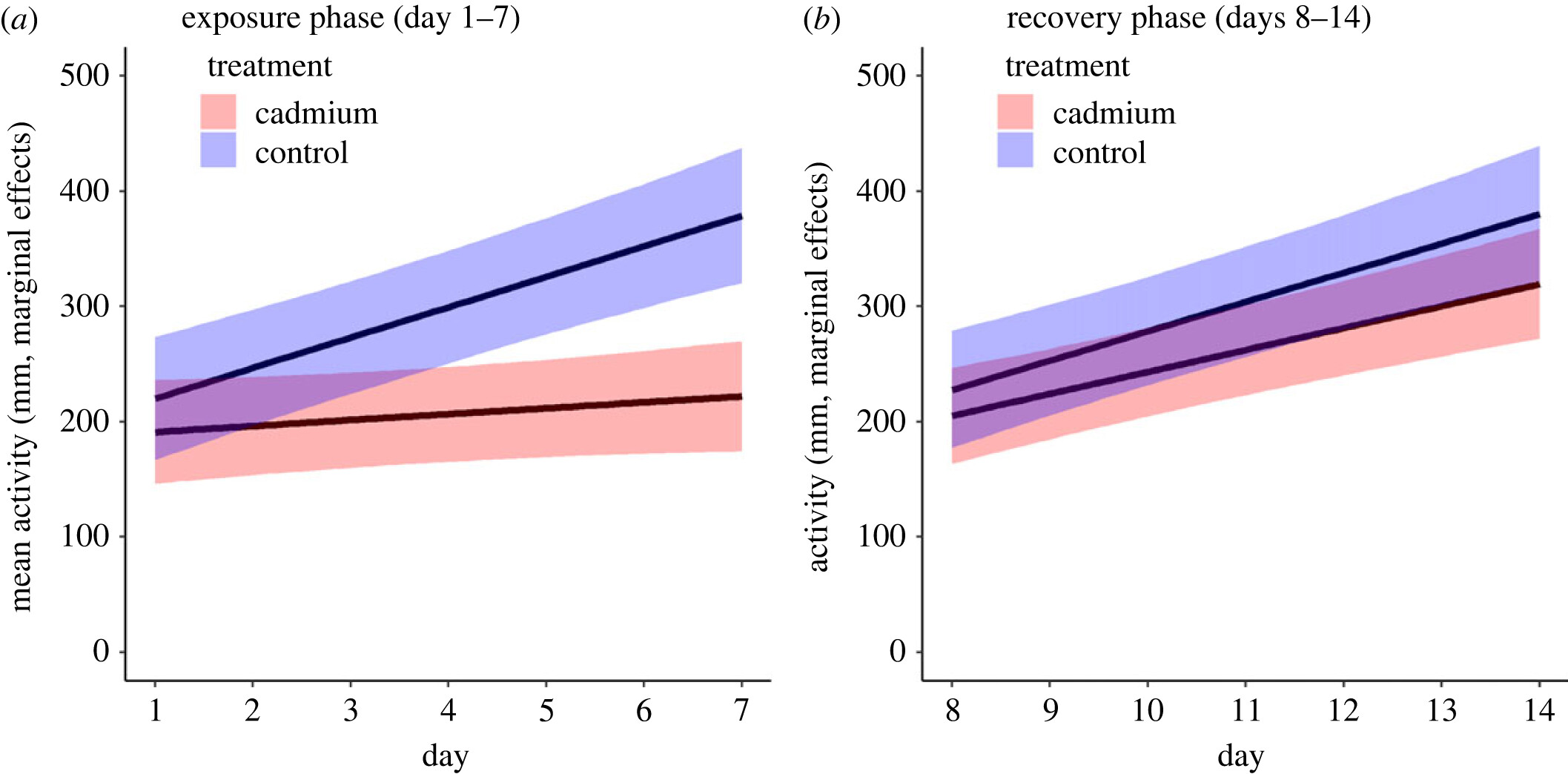
Here, we investigated the effects of a sublethal, short-term exposure to a carcinogen at environmentally relevant concentrations on the activity patterns of wild Girardia tigrina planaria during a two-phase experiment, consisting of a 7-day exposure to cadmium period followed by a 7-day recovery period. To comprehensively explore the effects of the exposure on activity patterns, we employed the double hierarchical generalized linear model framework which explicitly models residual intraindividual variability in addition to the mean and variance of the population.

We found that exposed planaria were less active compared to unexposed individuals and were able to recover to pre-exposure activity levels albeit with a reduced variance in activity at the start of the recovery phase. Planaria showing high activity levels were less predictable with larger daily activity variations and higher residual variance. Thus, the shift in behavioural variability induced by an exposure to a cancer risk factor can be quantified using advanced tools from the field of behavioural ecology. This is required to understand how tumourous processes affect the ecology of species.

The effect of mitochondrial recombination on fertilization success in blue mussels

Authors: Georgina Bramwell, Aaron G. Schultz, Geordie Jennings, Urmi Nishat Nini, Caitlin Vanbeek, Peter A. Biro, Christa Beckmann, Antoine M. Dujon, Frédéric Thomas, Craig D.H. Sherman, Beata Ujvari

Source: Science of The Total Environment (Dec 2023)

Abstract

The presence of doubly uniparental inheritance (DUI) in bivalves represents a unique mode of mitochondrial transmission, whereby paternal (male-transmitted M-type) and maternal (female-transmitted F-type) haplotypes are transmitted to offspring separately. Male embryos retain both haplotypes, but the M-type is selectively removed from females.

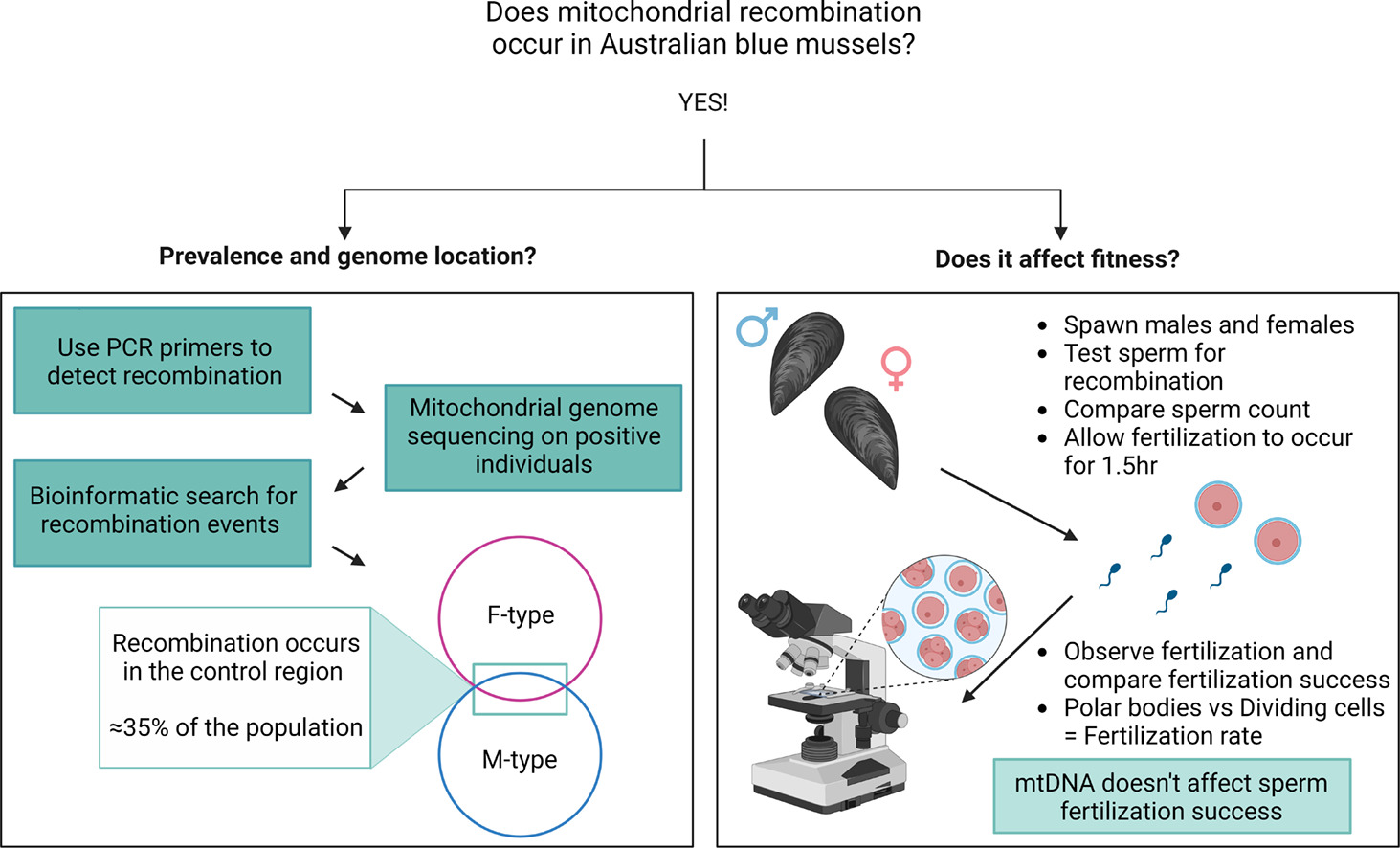
Due to the presence of heteroplasmy in males, mtDNA can recombine resulting in a ‘masculinized’ haplotype referred to as Mf-type. While mtDNA recombination is usually rare, it has been recorded in multiple mussel species across the Northern Hemisphere. Given that mitochondria are the powerhouse of the cell, different mtDNA haplotypes may have different selective advantages under diverse environmental conditions. This may be particularly important for sperm fitness and fertilization success. In this study we aimed to i) determine the presence, prevalence of the Mf-type in Australian blue mussels (Mytilus sp.) and ii) investigate the effect of Mf-mtDNA on sperm performance (a fitness correlate).

We found a high prevalence of recombined mtDNA (≈35 %) located within the control region of the mitochondrial genome, which occurred only in specimens that contained Southern Hemisphere mtDNA. The presence of two female mitotypes were identified in the studied mussels, one likely originating from the Northern Hemisphere, and the other either representing the endemic M. planulatus species or introduced genotypes from the Southern Hemisphere. Despite having recombination events present in a third of the studied population, analysis of sperm performance indicated no difference in fertilization success related to mitotype.

Genetic divergence of farmed blue mussels (Mytilus sp.) in Australian waters

Authors: Georgina Bramwell, Aaron G. Schultz, Thomas Madsen, Frédéric Thomas, Nick Macdonald, Antoine M. Dujon, Craig D.H. Sherman, Beata Ujvari

Source: Aquaculture (Sep 2023)

Abstract

As valuable ecosystem engineers, blue mussels, are one of the most ecologically and economically important bivalve species in Australia. The need for understanding levels of genetic diversity in both wild and farmed populations of Australian mussels is ever-growing due to the increased risk of disease and decreased fitness associated with the constantly changing global environment.

This study, therefore, investigated the phylogenetic relationship, and the genetic variation of farmed blue mussels (Mytilus sp., previously noted as M. galloprovincialis, M. planulatus or a hybrid of both) at four sites along the south coast of Australia, Victoria, South Australia, Western Australia, and Tasmania.

Analyses of two genes, Cytochrome c oxidase subunit 1 gene (mtCOI) and the nuclear gene Elongation factor 1 alpha (EF1a) was completed for all mussels sampled. The phylogenetic reconstruction of mtDNA sequences was not able to cluster the samples into species. The analyses of the nuclear marker (EF1a) returned similar results, except that we could conclude the Australian samples not being M. chilensis. Furthermore, the analyses of EF1a revealed the presence of hybridisation, a pattern commonly observed in mussels.

The genetic diversity analysis of mtCOI demonstrated that samples from Victoria and Western Australia had the highest genetic diversity, while South Australia had the lowest. When analysing the nuclear EF1a sequences, mussels from Western Australian had the lowest genetic diversity, and the Victorian samples had the highest.

The study extended our knowledge on the population genetic variation of farmed blue mussels (Mytilus sp.) along the south coast of Australia. The identified genetic differences between the four southern states of Australia could be interesting for the aquaculture industry when aiming for more adaptable and profitable stocks.

Cancer hygiene hypothesis: A test from wild captive mammals

Authors: Antoine M. Dujon, Jérémy Jeanjean, Orsolya Vincze, Mathieu Giraudeau, Jean-François Lemaître, Pascal Pujol, Beata Ujvari, Frédéric Thomas

Source: Ecology and Evolution (Sep 2023)

Abstract

The hygiene hypothesis, according to which the recent reduction of exposure to infectious agents in the human species would be the origin of various diseases, including autoimmune diseases and cancer, has often been proposed but not properly tested on animals.

Here, we evaluated the relevance of this hypothesis to cancer risk in mammals in an original way, namely by using information on zoo mammals. We predicted that a higher richness of parasitic cohorts in the species’ natural habitat would result in a greater occurrence of evolutionary mismatch due to the reduction of parasites in captive conditions. This, in turn, could contribute to an increased risk of developing lethal cancers.

Using a comparative analysis of 112 mammalian species, we explored the potential relationship between cancer risk and parasite species richness using generalized phylogenetic least squares regressions to relate parasite species richness to cancer risk data.

We found no strong evidence that parasite species richness increased cancer risk in zoo mammals for any of the parasite groups we tested. Without constituting definitive proof of the irrelevance of the hygienic hypothesis, our comparative study using zoo mammals does not support it, at least with respect to cancer risks.

Effect of MHC and inbreeding on disassortative reproduction: A data revisit, extension and inclusion of fertilization in sand lizards

Authors: Badreddine Bererhi, Pierre Duchesne, Tonia S. Schwartz, Beata Ujvari, Erik Wapstra, Mats Olsson

Source: Ecology and Evolution (Mar 2023)

Abstract

The harmful effects of close inbreeding have been recognized for centuries and, with the rise of Mendelian genetics, was realized to be an effect of homozygosis. This historical background led to great interest in ways to quantify inbreeding, its depression effects on the phenotype and flow-on effects on mate choice and other aspects of behavioral ecology.

The mechanisms and cues used to avoid inbreeding are varied and include major histocompatibility complex (MHC) molecules and the peptides they transport as predictors of the degree of genetic relatedness.

Here, we revisit and complement data from a Swedish population of sand lizards (Lacerta agilis) showing signs of inbreeding depression to assess the effects of genetic relatedness on pair formation in the wild. Parental pairs were less similar at the MHC than expected under random mating but mated at random with respect to microsatellite relatedness. MHC clustered in groups of RFLP bands but no partner preference was observed with respect to partner MHC cluster genotype. Male MHC band patterns were unrelated to their fertilization success in clutches selected for analysis on the basis of showing mixed paternity.

Thus, our data suggest that MHC plays a role in pre-copulatory, but not post-copulatory partner association, suggesting that MHC is not the driver of fertilization bias and gamete recognition in sand lizards.

Spontaneously occurring tumors in different wild-derived strains of hydra

Authors: Justine Boutry, Marie Buysse, Sophie Tissot, Chantal Cazevielle, Rodrigo Hamede, Antoine M. Dujon, Beata Ujvari, Mathieu Giraudeau, Alexander Klimovich, Frédéric Thomas & Jácint Tökölyi

Source: Scientific Reports (May 2023)

Abstract

Hydras are freshwater cnidarians widely used as a biological model to study different questions such as senescence or phenotypic plasticity but also tumoral development. The spontaneous tumors found in these organisms have been so far described in two female lab strains domesticated years ago (Hydra oligactis and Pelmatohydra robusta) and the extent to which these tumors can be representative of tumors within the diversity of wild hydras is completely unknown.

In this study, we examined individuals isolated from recently sampled wild strains of different sex and geographical origin, which have developed outgrowths looking like tumors. These tumefactions have common features with the tumors previously described in lab strains: are composed of an accumulation of abnormal cells, resulting in a similar enlargement of the tissue layers. However, we also found diversity within these new types of tumors. Indeed, not only females, but also males seem prone to form these tumors. Finally, the microbiota associated to these tumors is different from the one involved in the previous lineages exhibiting tumors. We found that tumorous individuals hosted yet undescribed Chlamydiales vacuoles.

This study brings new insights into the understanding of tumor susceptibility and diversity in brown hydras from different origins.